
Everyone is used to running Google ads campaigns, but only a few keep track of them. Monitoring the campaigns and their success in the past can make future decisions and campaigns more secure.
In this blog, we’ll be going through the concept of measuring the Google Ads campaigns. This will help you measure the metrics and improve your overall campaign’s performance.
Using Google Ads is a great way of reaching your target market and expanding your company. Placing ads, however, is just not enough. But what do you monitor to ensure that they are working? Let’s find out in the following sections.
Table of Content
Ways to Measure the Success of Your Google Ads Campaigns
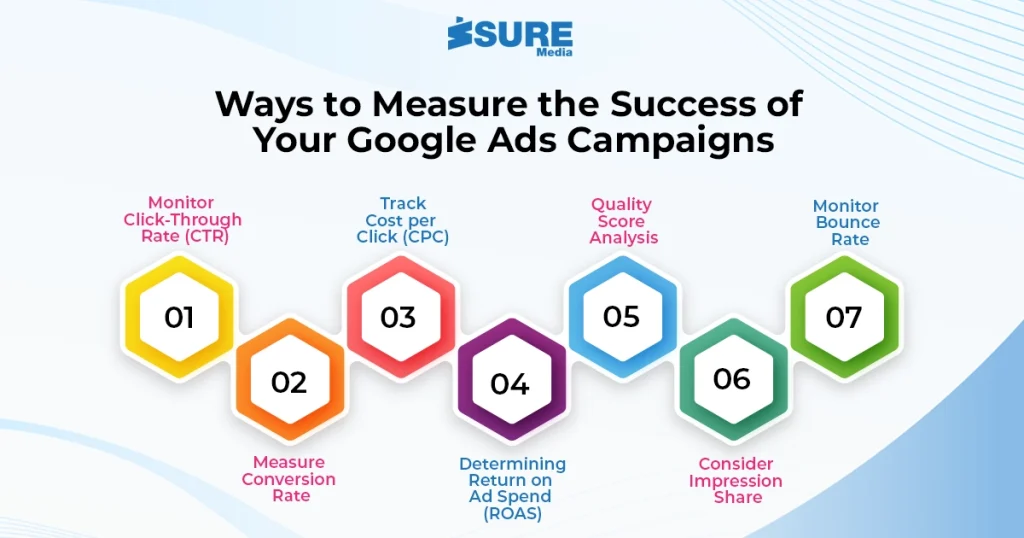
Following are the ways through which you can measure the performance of your Google Ads campaigns.
1. Monitor Click-Through Rate (CTR)
Click-through rate or CTR is the number of times individuals click on your advertisement every time you display it to them. A good CTR means a good campaign management and pertinent advertisement strategies. In addition, it displays how well you are performing in Google Ads campaigns.
For example, if your advertisement receives 100 clicks and 1,000 impressions, then your CTR is 10%.
A CTR will differ depending on your niche, but the higher the percentage, the better your ad copy and targeting are. If your CTR is low, try to replace other headlines, descriptions, or keywords.
2. Measure Conversion Rate
Google ads campaigns usually get clicked, but what’s more important is that they turn into potential customers. The conversion rate shows how your campaigns have performed and how you have taken care of your customer’s needs.
The end result might include buying, subscribing to a newsletter, or completing a contact form.
To increase the conversion rates, make sure that your landing pages match your ad copy. In addition, they load fast, and have the call-to-action (CTA) buttons with the. If individuals click but fail to convert, then perhaps there is something wrong with your offer or site experience.
3. Track Cost per Click (CPC)
Each time a user clicks your ad, Google charges you. Cost-per-click or CPC is how much you get charged for a visitor. Reducing your CPC without losing quality traffic is how you increase profitability.
If your CPC is too high, then you might need to execute another bid strategy, optimize Quality Score, or optimize keyword targeting. Google likes low-cost, well-optimized ads, so always shoot for high engagement and relevance.
4. Determining Return on Ad Spend (ROAS)
Return on Ad Spend or ROAS is a measurement that informs you about how much you earn on every dollar spent on adverts. To figure it out, you divide ad spend by conversion value. For example, if you spent $100 on adverts and received $500 on revenue, then your ROAS is 5x.
Return on Ad Spend or ROAS is a measurement that informs you about how much you earn on every dollar spent on adverts. To figure it out, you divide ad spend by conversion value. For example, if you spent $100 on adverts and received $500 on revenue, then your ROAS is 5x.
5. Quality Score Analysis
Google gives your ads a Quality Score for relevance, estimated CTR, and landing page quality. The higher your Quality Score, the more competitive your CPC and the better your ad positions.
To increase your Quality Score, make good ads, use good keywords, and make good landing pages. The more optimized your ad experience is, the less you’ll pay per click.
6. Consider Impression Share
Impression share lets you know how many times your ads really are getting seen and compares them to how often they could be seen. A low impression share would indicate low bids or a low budget. Raising bids, improving your Quality Score, or increasing budget can increase your impression share. This puts you into contention and in front of more leads.
7. Monitor Bounce Rate
Bounce rate tells you about the individuals who leave your site after looking at one page. If you have a high bounce rate, it means that your landing page is not interesting or relevant enough.
To minimize the bounce rates, ensure that your landing pages are in line with the intention of your ads, load within zero seconds, and have a distinct next step for the visitors. An optimized page captivates the audience and generates maximum conversions.
Final Thoughts
Tracking the performance of your Google Ads campaigns is the key to optimizing and maximizing ROI. Tracking such important metrics as CTR, conversion rate, CPC, and ROAS, you can determine what is and isn’t working.
With the right adjusting, you’re able to refine your campaigns, eliminate wasteful spend, and maximize your outcome. Continue testing, tracking, and optimizing your approach to see your ad spend maximized!
If you want any sort of help with Google Ad Campaigns, then you can click on the button below.
You can connect with our social media handles from the following links: