
The marketing world loves trends. Every year, something “revolutionary” arrives to replace everything we already know. First it was email, then it was social media, then analytics dashboards, and now…automation.
But here’s where it gets interesting. Automation itself has now split into two big directions:
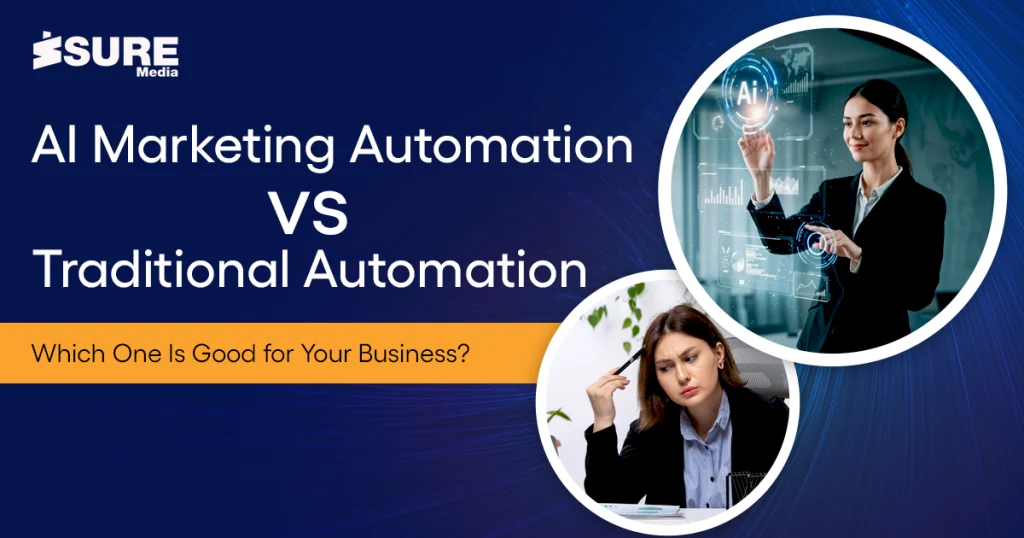
Traditional automation and AI marketing automation.
Traditional automation and AI marketing automation.
One follows instructions like a loyal assistant.
The other thinks, learns, and adjusts like a smart teammate.
The other thinks, learns, and adjusts like a smart teammate.
So which one does your business actually need?
Let’s break it down — no tech dictionary, no complicated terms. Just human talk.
Let’s break it down — no tech dictionary, no complicated terms. Just human talk.
Table of Content
Introduction
What is traditional automation?
What is AI Marketing automation
Where do they differ?
When is traditional automation better for your business?
When does AI marketing automation become a game-changer
Which one should you choose?
The real question that you should ask yourself
Final Thought
What is Traditional Automation (in simple words)?
Traditional automation does what you tell it to do.
You set rules → it follows them → it never questions anything.
You set rules → it follows them → it never questions anything.
For example:
- If someone fills a form → send them an email
- If someone clicks a link → send them offer A
- If someone buys → send them a thank-you message
It’s reliable, predictable, and perfect for routine tasks.
It won’t think for you, but it will save you hours.
It won’t think for you, but it will save you hours.
Then, what is AI Marketing Automation?
Think of it as automation with a brain.
It doesn’t just follow rules — it learns and adjusts.
It doesn’t just follow rules — it learns and adjusts.
Instead of saying,
“If someone clicks twice, send email A.”
AI marketing automation watches patterns and takes smarter decisions, like:
“This person interacts more with videos, not emails — let’s send a video message.”
“If someone clicks twice, send email A.”
AI marketing automation watches patterns and takes smarter decisions, like:
“This person interacts more with videos, not emails — let’s send a video message.”
It adapts based on behavior.
It studies your audience without complaints.
And it tries to get better results with less human effort.
It studies your audience without complaints.
And it tries to get better results with less human effort.
So… Where do they differ?
Let’s not get fancy. Here’s the simplest difference ever:
| Traditional Automation | AI Marketing Automation |
|---|---|
| Runs on rules you set | Runs on data it learns |
| Good for repeated tasks | Good for improving results |
| You control everything | You guide while AI optimizes |
| Predictable outcome | Evolving outcome |
| Needs frequent updates | Self-optimizing |
Both have strengths.
Neither is the enemy.
The real question is — what does your business need right now?
Neither is the enemy.
The real question is — what does your business need right now?
When Traditional Automation Is Perfect for Your Business
If you’re thinking:
“We just need things to work on time without chaos.”
Traditional automation is your best friend.
“We just need things to work on time without chaos.”
Traditional automation is your best friend.
It shines when:
- You have a small team
- You want predictable processes
- Your campaigns rarely change
- You follow the same system for every client
It takes care of the boring, repetitive work so you can focus on the creative and money-making work.
No overthinking. No expensive tech upgrades. Just reliable help.
No overthinking. No expensive tech upgrades. Just reliable help.
When AI Marketing Automation Becomes a Game-Changer
AI comes in when you want to get smarter, not just faster.
It helps when:
It helps when:
- Your audience behaves differently across segments
- You want to personalize campaigns for every type of customer
- You want to increase conversions without increasing workload
- You want the system to tell you what works instead of guessing
AI marketing automation takes the pressure off your decision-making.
It analyzes trends for you, learns what gets the best results, and adjusts campaigns automatically.
It analyzes trends for you, learns what gets the best results, and adjusts campaigns automatically.
Less trial and error. More results.
So, which one should you choose?
Here’s the most honest answer you’ll ever get:
Your business might need both.
Your business might need both.
Traditional automation builds your structure.
AI marketing automation improves your performance inside that structure.
AI marketing automation improves your performance inside that structure.
It’s like building a car first (traditional)…
and then installing autopilot (AI).
and then installing autopilot (AI).
If you’re just starting, traditional automation is more than enough.
If you’re growing fast, AI will multiply your results without multiplying your workload.
If you’re growing fast, AI will multiply your results without multiplying your workload.
The Real Question to Ask Yourself
Forget the features. Forget the buzzwords.
Ask only this:
Ask only this:
“Do I want systems that follow instructions, or systems that think for me?”
If you want consistency → go traditional.
If you want speed, personalization, and higher conversions → lean toward AI marketing automation.
If you want both efficiency and performance → use both.
If you want speed, personalization, and higher conversions → lean toward AI marketing automation.
If you want both efficiency and performance → use both.
No shame. No competition. Just smart decision-making.
Final Thought
Marketing is not about using the fanciest tools.
It’s about choosing systems that match your growth stage.
It’s about choosing systems that match your growth stage.
Traditional automation keeps things running smoothly.
AI marketing automation helps you win in competitive markets by learning your audience faster than humans can.
AI marketing automation helps you win in competitive markets by learning your audience faster than humans can.
And that’s the goal — not to work harder, but to work smarter while your business keeps growing.
You can also connect with us via our social media handles.