

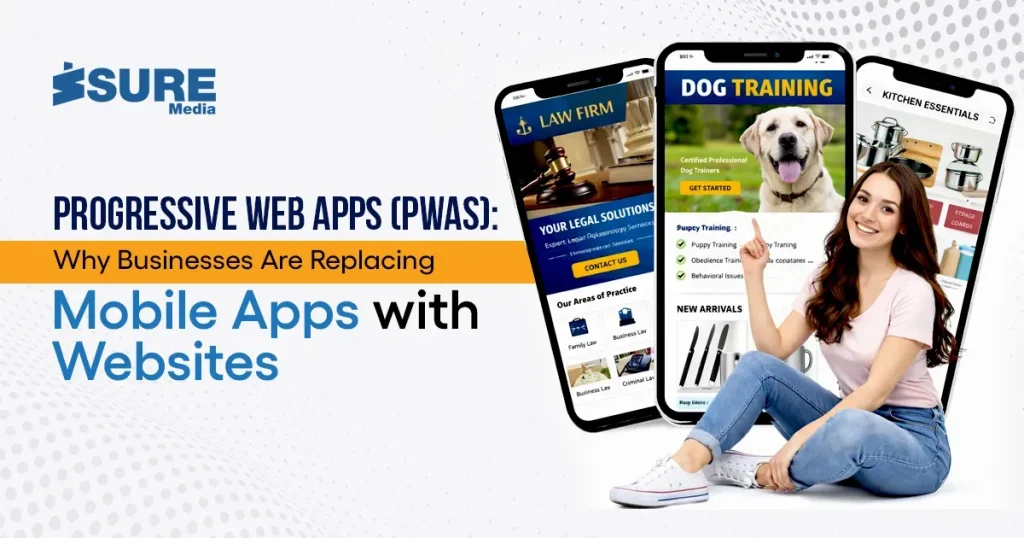
Progressive Web Apps (PWAs): Why Businesses Are Replacing Mobile Apps with Websites

Picture of Harish Pandey

Harish Pandey

CEO, Isuremedia

Why Businesses Are Replacing Mobile Apps with Websites blog banner-image
For years, the standard advice for any growing business was simple: “You need an app.” Companies spent tens of thousands of dollars building separate versions of the same product for iOS and Android, only to struggle with getting users to actually download them.
But the landscape has shifted. Today, the most successful companies are turning toward Progressive Web Apps (PWAs), a technology that allows a website to act, feel, and perform exactly like a mobile app without the friction of an app store. When considering PWA development, it’s clear that the modern web has finally caught up to usual app functionality.

Table of Content

What exactly is a Progressive Web App (PWA)?

A Progressive Web App acts as a bridge between a website and a mobile app. It gives your users the speed and ‘home screen’ presence of a traditional app, but with the ease of access of a standard website.
When a user visits your site, they get a prompt to “Add to Home Screen.” Once they do, the browser UI (the search bar and tabs) disappears, and your site looks like a standalone app. One of the key benefits of progressive web apps is their ability to send push notifications, work offline, and load instantly – all without the user ever visiting the Apple App Store or Google Play Store.

Why the Shift is Happening

Businesses are moving away from traditional mobile apps to progressive web apps for three primary reasons:

1. Seamless Onboarding: One Tap to Install

To use a traditional app, a user has to:
  • Search the App Store.
  • Enter a password or use FaceID.
  • Wait for a 100MB download.
Installing a PWA is as simple as clicking a button while browsing. By removing the need to search, download, and wait, you create a seamless transition from visitor to app user, drastically reducing drop-off rates compared to traditional apps.

2. Development & Maintenance Costs

Building a native app usually requires three separate teams: one for the website, one for iOS (Swift), and one for Android (Kotlin).
A PWA uses one codebase. When you update your website, your “app” is updated instantly. You no longer have to wait days for Apple or Google to “approve” your latest version or fix a bug. This significantly reduces the Total Cost of Ownership (TCO) for your digital presence.

3. SEO and Discoverability

Traditional applications require App Store Optimization (ASO) to be found. PWAs, however, are websites. This means every page of your web app can be indexed by search engines and benefit from traditional SEO allowing you to gain organic traffic that traditional apps simply cannot reach.

Real-World Success

Many global leaders have already seen the benefits of progressive web apps firsthand: For example:
  • Starbucks: Built a PWA that is 99% smaller than their iOS app, leading to a 2x increase in daily active users.
  • Twitter (X): Their PWA, Twitter Lite, saw a 75% increase in tweets sent because it loads faster on slow networks.
  • Pinterest: Saw a 60% increase in core engagement after replacing their slow mobile site with a PWA. .

Is a PWA right for you?

Choosing between a PWA and a native app comes down to your business goals. If your app requires heavy processing (like a high-end 3D game) or needs deep access to specialized hardware (like the iPhone’s FaceID sensors), a traditional app might still be necessary.
However, for E-commerce, SaaS, News, and Service-based businesses, a PWA offers the best of both worlds: the reach of the web and the engagement of an app.

Ready to Upgrade Your Digital Presence?

Don’t let a slow website or a complex app store process hold your business back. At Isuremedia, we specialize in transforming standard websites into high-performance Progressive Web Apps Development that drive results. From push notifications to offline functionality, we build the tools you need to stay ahead of the time. Contact Isuremedia today to get a free audit of your current site and see how a PWA can revolutionize your customer journey.
Let’s Build a Faster, More Engaging Experience for Your Users.

Frequently Asked Questions

A Native App is built for a specific operating system (iOS or Android) and must be downloaded from an app store. A Progressive Web App is a high-performance website that runs in a browser but can be installed on a home screen, offering app-like features like push notifications and offline access without the download friction.

Yes. While Apple was slower to adopt the technology, modern iOS versions fully support PWAs. Users can add them to their home screen via the “Share” menu, and they now support web push notifications, which was the final major hurdle for Apple users.

Yes. One of the core features of a Progressive Web App is the use of “Service Workers.” These scripts cache your website’s essential data, allowing users to browse previously loaded content, submit forms, or use tools even when they are completely offline.

Generally, a Progressive Web App costs 50% to 75% less to develop and maintain. This is because you only build one codebase that works across all devices, rather than hiring separate teams for a website, an iPhone app, and an Android app.

Absolutely. Since a PWA is basically a website, Google can crawl and index every page. Because Progressive Web Apps are optimized for extreme speed and mobile-friendliness (core ranking factors), they often rank significantly higher than traditional responsive websites.

Yes. Progressive Web Apps use the Web Push API to send notifications to users’ devices, even when the browser is closed. This is a powerful tool for e-commerce abandoned cart reminders or real-time news alerts.

You don’t need an app store. When you visit a PWA-enabled site, you will see a prompt (or can manually select) “Add to Home Screen.” Once clicked, the app icon appears on your phone instantly, just like a usual app.

Scroll to Top