
Forget Search Engines: SEO is Now Search Everywhere Optimization

Picture of Harish Pandey

Harish Pandey

CEO, Isuremedia

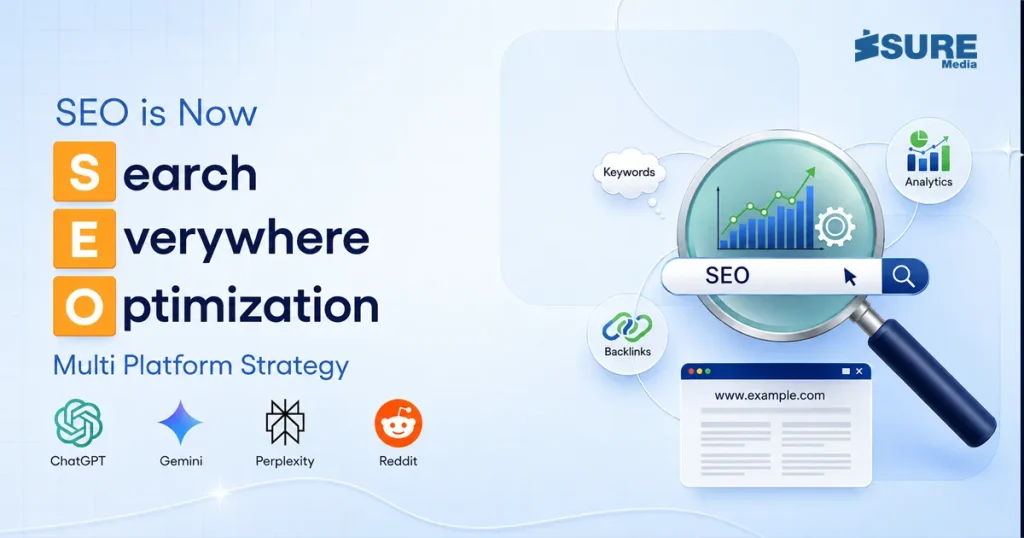
The traditional path to getting found online is not relevant anymore. SEO is now Search Everywhere Optimization. Marketing teams spend months trying to force a website page to rank number one on Google, only for Google to summarize the entire article in an AI box anyway. The user gets the answer, closes the tab and the website gets zero clicks.
People are bypassing standard search bars to look for answers inside social feeds, community threads and AI chatbots. Because of this, optimization cannot live on your website alone anymore.

What is Search Everywhere Optimization?

Search Everywhere Optimization (SEO) is a marketing setup where you optimize your content to be found inside social media apps, online marketplaces and AI tools instead of just web browsers. It ensures your business shows up whenever and wherever your audience asks a question.
In the past, the path to buying a product was simple:
  • Step 1: A user had a problem.
  • Step 2: They opened a web browser.
  • Step 3: They typed the issue or product into Google.
  • Step 4: They clicked the top links to compare.
Today, that path is broken into pieces. A user might discover a product on TikTok, jump over to Reddit to see what real people think about it and then ask an AI tool like Gemini or ChatGPT to list the pros and cons. If your business only lives on a website, you miss out on almost the entire journey.
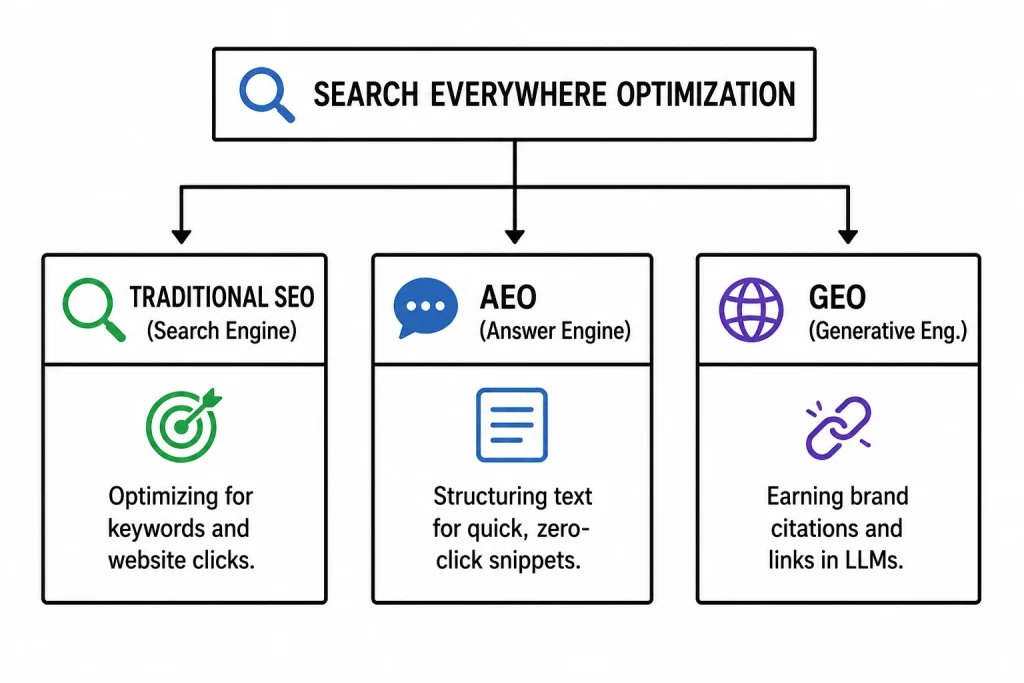
To grow in today’s market, you must show up across three separate layers:
Flowchart explaining the three layers of Search Everywhere Optimization: Traditional SEO, AEO, and GEO.

Why Old Google Search is Sinking

Traditional search clicks are dropping fast. This happens because AI engines and social networks give users immediate answers without forcing them to click through to a website. This means people get the facts they need right away on the search page.

Zero-Click Search

Organic clicks to websites are dropping because Google’s new AI Overviews answer user questions instantly at the very top of the screen. The user gets their answer and leaves without ever visiting a blog or site.

Social Search Habits

Younger consumers use TikTok or Instagram as their main search engine when they want to find new restaurants, travel spots, products or fashion trends. They want quick video proof from a fellow user.

Community

When people want honest reviews about a product, they type the word “Reddit” or “Quora” at the end of their search. They do this because they want to know what people have to say about that business.
Because of these new habits, you cannot just write for a single Google algorithm anymore. You have to leave a trail of helpful content across the whole web.

Author’s POV: Stop "AI Proofing" Your Brand

From My Desk:
Here is something most marketing agencies will not tell you: You cannot trick an AI chatbot with basic keyword stuffing. Old SEO was all about satisfying the SEO parameters and web logics, while search everywhere optimization is building an undeniable brand presence. If ChatGPT search scripts scroll the web and find nobody talking about your business on Reddit, YouTube or other industry forums, the AI will simply act like you do not exist. You cannot buy your way into an LLM citation with spammy backlinks. You have to actually be talked about everywhere.

The Three Pillars of the New Strategy

To grow your business online today, you have to treat every social and AI app like a search engine. Each platform requires a clean, simple setup.

1. Social Search Optimization

Social networks use search bars to keep people inside their apps. When you post a video or a text update, you must make it easy for the app to categorize it.

  • TikTok and Instagram: The app reads your captions, the text on the screen, and the words you say out loud. So, if you sell skincare, say the words “Skincare” in the first three seconds of your video.
  • YouTube:YouTube is a massive search engine. To rank here, use simple titles that match exactly what people type, and add timestamps so users can skip to the answer.

2. Answer Engine Optimization (AEO)

Answer engines are tools that give a single, direct reply to a user’s question. This includes Google’s featured text snippets and voice search tools.

  • Keep it Brief: Write short definitions. If your writing is complex, the computer cannot pull your data.
  • Use Data Formatting: You can make your page highly readable by using simple tables to compare facts.
Search Type Where It HappensWhat Users Want
Traditional SEOGoogle Blue LinksDeep research and long articles.
AEO StrategyAI Snippets & BlocksFast, direct answers to quick questions.
Social SearchTikTok, YouTube, Reddit Real reviews, video proof and opinions.

3. Generative Engine Optimization (GEO)(AEO)

This is the process of getting your brand mentioned inside AI chatbots like ChatGPT, Claude and Gemini.

  • AI Discovery: When a user asks an AI tool to recommend a service, the AI looks through its data index to find trusted names.
  • Trust Factors: So, to make sure the AI picks your business, your website must feature real customer case studies, exact numbers and direct quotes from experts.

The "One-to-Many" Content Hack
Most businesses panic when they hear they need to optimize for ten different platforms. They think they need to hire a massive team to create separate content for every app.
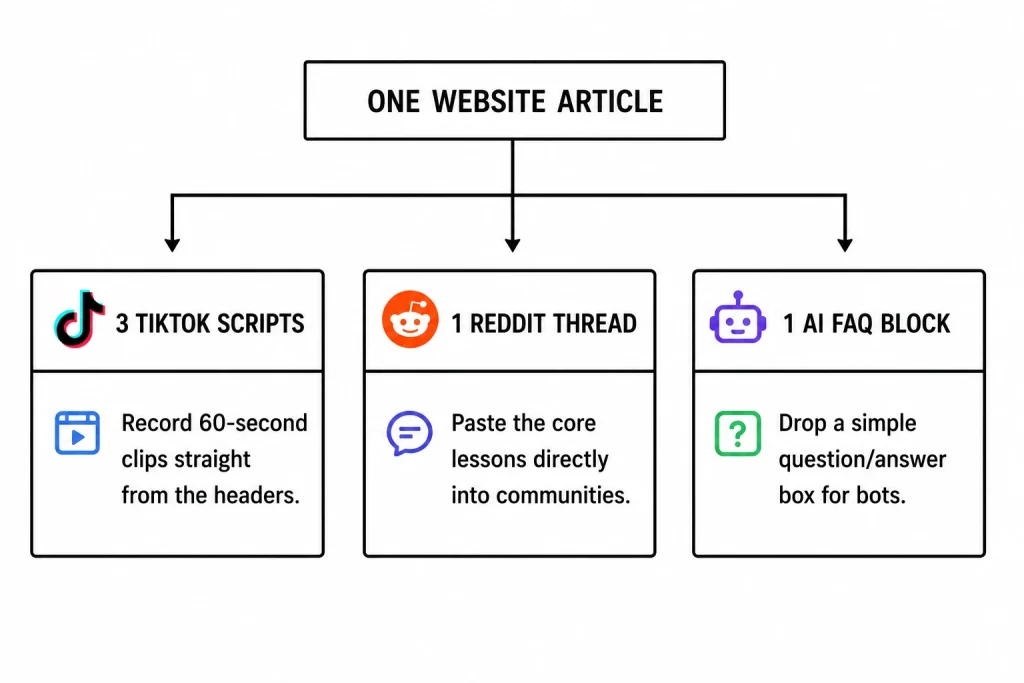
But you can actually run this entire strategy by using a simple “One-to-Many” workflow. It allows you to build a multi-platform footprint without spending all week on content creation.
Diagram showing the one-to-many content workflow for multi-platform search visibility.
In the past, the path to buying a product was simple:
  • Step 1: Write one highly detailed page on your website that answers a customer problem directly. Put a short summary at the top so AI bots can easily copy it.
  • Step 2: Take the main subheadings from that blog and turn them into 60-second video scripts. Keep the words simple and cut out any fluff. Then, post these clips on YouTube Shorts and TikTok with your target keywords in the caption.
  • Step 3: Summarize your main points into a helpful post for social feeds. Do not just drop a link and tell people to visit your website. Instead, give away the core solution for free right inside the post to build real trust.

Simple Rules That Keep Your Content Alive

Google uses specific systems to grade how helpful your content is. If your text is hard to read or looks like an unedited block of text, people will click away and your rank will drop.
  • Keep Paragraphs Short: Use a maximum of three sentences per paragraph. This makes your text easy to read on a mobile phone screen.
  • Use Simple Words: Avoid complex corporate jargon. Write “use” instead of “utilize.” Write “run” instead of “operationalize.” Clear words help both humans and AI bots index your text faster.
  • Write in the Active Voice: Active sentences give your writing momentum. For example, instead of writing “A drop in traffic was seen by our team,” write “Our team saw a drop in traffic.

Secure Your Traffic Now

Write a short, clear, and professional description (up to 750 characters). In particular, make the first 250 characters strong and engaging.
By using a Search Everywhere Optimization plan, you stop worrying about constant Google updates. Instead, you put your brand right where your customers already spend their time.
If your web traffic has dropped recently, or if you want to protect your business against new AI search updates, we can help. We build clean, multi-platform plans that keep your business visible across Google, social apps and AI engines alike.
Let’s review your digital footprint and find out exactly where your customers are searching for you.
Scroll to Top